
The Hardmans' House

On a grey and very wet day in September, I had the chance to visit one of Liverpool’s great heritage sites – The Hardmans’ House in Rodney Street. An iconic venue, and one that I believe all photographers with an interest in photographic history should visit.

Edward Chambré-Hardman began his adult life in the army, where he was posted to India and served alongside his future business partner, Kenneth Burrell. On returning to England, they set up the Burrell & Hardman studio at 51a Bold Street in Liverpool in 1923, which at the time was one of the most prestigious addresses in the city.
Their reputation grew quickly and they soon acquired a select clientele, partly through their association with the theatre. Among their famous subjects were Margot Fonteyn, Michael Redgrave, Ivor Novello and many others.
Margaret Mills joined the business as a photographic assistant in 1926, and in 1932 she and Chambré were married. In 1938, they opened a second studio in Chester, at St Werburgh Street, to cope with the growing success of the business.
By 1949, the Bold Street lease had expired and the Hardmans moved lock, stock and barrel to 59 Rodney Street, where their home and studio would remain for the rest of Chambré’s life. The house is now regarded as one of the most complete surviving examples of a mid-20th-century photographic studio, with the studio, darkrooms, equipment, business records and personal effects all preserved.

Following Margaret’s death in 1970, Chambré’s health began to decline. In 1979, following a fall, Social Services introduced him to Peter Hagerty, then Director of Open Eye Gallery in Liverpool. Hagerty quickly recognised the significance of the Hardmans, their house, studio and the enormous photographic collection accumulated there. The E. Chambré Hardman Trust was subsequently established to preserve the house and collection.
After Chambré’s death in 1988, the Trust continued its work, and in 2003 the collection was gifted to the National Trust. The photographic and archival collection, comprising more than 140,000 objects, is now held at Liverpool Record Office. It represents an extraordinary record of the life and work of the Hardmans and is one of the most complete photographic collections of its kind.
Entering the narrow hallway, as so many had done before me, I was immediately struck by how dimly lit it was. All the lights were on, yet there was still a slightly claustrophobic feel, despite the fact that this was a four-storey building. Nothing appeared to have changed – not the lighting, the décor, or the way they had lived since the 1950s.


The waiting room was little more than a modestly furnished sitting room, not unlike one you might have found in a reasonably well-off post-war home. Even the original gas fire was still in place. The furniture was comfortable but sparse, with examples of their work and a price list laid out for prospective clients to look through while they waited.
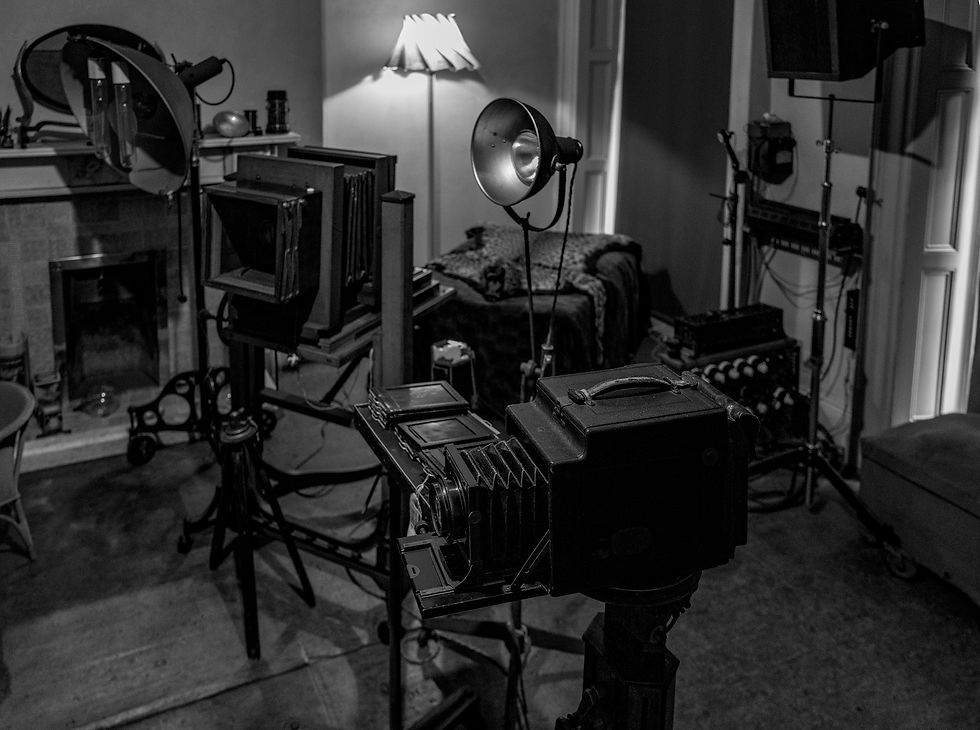
The actual studio was on the first floor and was quite cluttered. It may not have been quite so untidy during sittings, but the cameras, props and lighting equipment were the originals used by the Hardmans and their staff. The windows were blacked out, allowing them complete control over the artificial lighting.
The working darkroom was in the basement and was off limits to visitors, but we were told that the negatives were transferred to “coffins” – heavy metal cases in which the post-shoot negatives had to be carried downstairs by staff for processing.


The Hardmans’ personal darkroom was on the top floor and was very much their own creative space. Everything had been left as it was found, including most of the chemical jars.


A facsimile of one of their most reproduced negatives, The Birth of the Ark Royal, was left on an easel, with the original print displayed on the wall close by. The photograph itself was made in 1950, when the aircraft carrier was nearing completion at Cammell Laird in Birkenhead.
The Hardmans’ living quarters were surprisingly modest. They managed to fit themselves into just three small rooms – a kitchen, parlour and bedroom – together with a small bathroom. For them, it seems, everything was about running a successful business; living space was simply a necessary hindrance.

Margaret’s office was equally revealing – neat, tidy and positioned in front of a large window. It offered a glimpse of the considerable organisational role she played in the running of the business, as well as reminding us that she was an accomplished photographer in her own right.

The final stage of the tour took us back to the working areas of the house, where the preparation and finishing of the photographs took place. It was probably the brightest part of the house, with a selection of dyes, colourings and all manner of other photographic paraphernalia.

It was a truly remarkable time capsule of a working photographic studio and home. What makes the place so fascinating is not simply the equipment or the photographs, but the fact that so much of the working environment has survived alongside them. For anyone interested in the history of photography, it offers an unusually intimate glimpse into a professional photographic practice that has otherwise largely disappeared.
The 2026 visitor season runs until 26 September, with the house reopening for tours next year. Visits are by guided tour and must be booked through the National Trust, with tours taking place at specific time slots. Details of the 2027 season should be checked with the National Trust when bookings open.


brilliant stuff, must get over there
Great info, Tom